
Layout guide
Keyboard layouts & sizes.
Before we tool a keycap set, the first question is always "which sizes and which standards does it need to cover?" Here is the map — full-size to 60%, and ANSI vs ISO vs JIS — from the side that has to make every cap fit.
By size: full-size ≈ 104–108 keys, TKL ≈ 87, 75% ≈ 82–84, 65% ≈ 66–68, 60% ≈ 61, 40% ≈ 44–48. By standard: ANSI (US) has a wide Enter and long left Shift; ISO (EU) has a tall L-shaped Enter plus an extra key; JIS (Japan) adds several keys around the spacebar. A keycap kit must carry the right Enter, Shift, bottom-row and extra caps to cover the layouts you sell into.
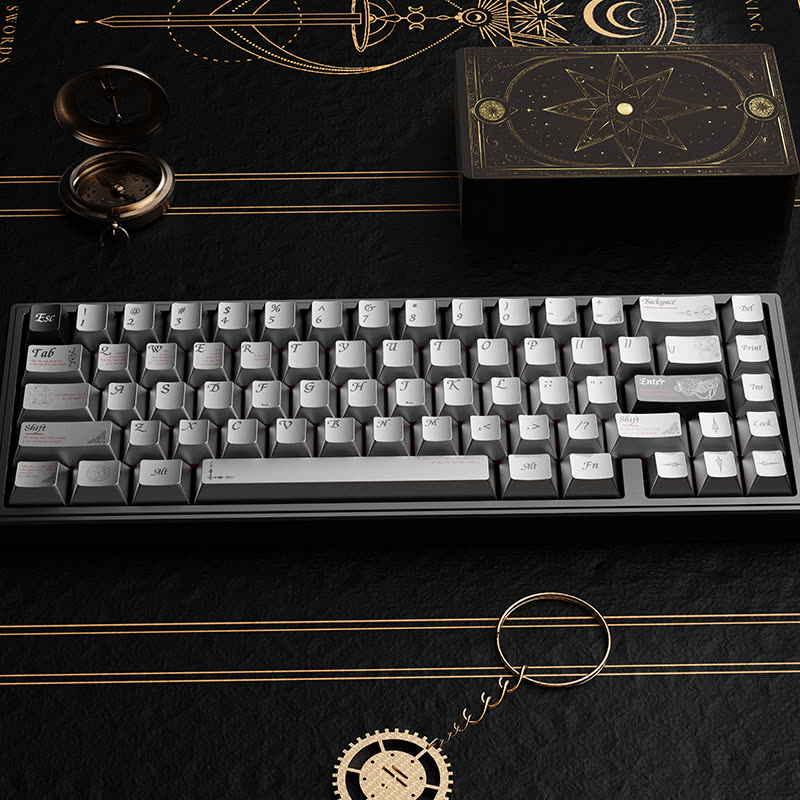
Keyboard sizes by key count
| Size | Approx. keys | What's dropped | Who it's for |
|---|---|---|---|
| Full-size (100%) | 104–108 | Nothing | Data entry, office, number-pad users |
| 1800 / 96% | ~98–100 | Gaps compressed, numpad kept | Numpad in a smaller footprint |
| TKL (80%) | 87–88 | Number pad | Gaming, desk space, most popular tenkeyless |
| 75% | 82–84 | Numpad; function row compressed | Compact with F-row and arrows |
| 65% | 66–68 | Function row; keeps arrows | Compact but arrow keys retained |
| 60% | ~61 | F-row, arrows, nav cluster | Minimalists; arrows via layers |
| 40% | 44–48 | Number row too | Enthusiast ultra-compact |
ANSI vs ISO vs JIS
Size tells you how many keys; the standard tells you their shape. This is where keycap kits succeed or fail to fit.
| ANSI | ISO | JIS | |
|---|---|---|---|
| Region | US & much of the world | Europe | Japan |
| Enter key | Wide, horizontal | Tall, L-shaped | Tall, L-shaped |
| Left Shift | Long | Short + extra key | Short + extra key |
| Spacebar area | One long spacebar | One long spacebar | Shorter space + extra keys |
| Approx. extra keys | Baseline | +1 vs ANSI | Several more than ANSI |
| Kit impact | Base kit | Needs ISO Enter, short Shift, extra cap | Needs JIS spacebar row + extra caps |
What layout means for a keycap kit
This is the part buyers underestimate. A keycap set is not one fixed list of caps — it is a base kit plus extension kits. To cover the sizes and standards above, a complete set needs: the alphas and common modifiers (base), a range of bottom-row modifier widths for different 60%/65% boards, an ISO Enter and short Shift, JIS caps if you sell into Japan, and stepped or non-stepped Caps Lock options. The more layouts you want one set to fit, the more unique caps we tool — and that feeds directly into cost and minimums.
Because every unique cap is another mold cavity and another QC lane, kit coverage is one of the biggest drivers of a keycap project's MOQ and cost. Deciding coverage before tooling is the single best way to control both.
How to spec layout coverage in your RFQ
Tell us three things and we can quote precisely: (1) which sizes the set must fit (e.g. TKL + 65% + 60%), (2) which standards (ANSI only, or ANSI + ISO + JIS), and (3) your profile — see the profiles we tool. With that, we map the exact kit list and the cap count that drives your quote.
FAQ
What is the difference between ANSI and ISO?
Mainly the Enter and left-Shift keys: ANSI has a wide Enter and long Shift; ISO has a tall L-shaped Enter, a shorter Shift with an extra key, and one more key overall.
How many keys is a 60% or TKL keyboard?
Roughly: 60% ≈ 61 keys, 65% ≈ 66–68, 75% ≈ 82–84, TKL ≈ 87, full-size ≈ 104–108. Exact counts vary by design.
Will one keycap set fit every keyboard?
Only if it includes enough kits — base alphas plus extras for different bottom rows, ISO/JIS support and stepped Caps Lock. Coverage depends on kit planning, not just key count.