Manufacturing process
Custom silk-screen printed keycaps.
Silk-screen (pad) printing is the economical way to put a crisp logo, single-color legend or decorative line art on a cap — including PC, transparent and specialty finishes that other processes can't handle.
Process: ink transferred onto the cap surface through a screen / pad, then coated for wear. Materials: PBT, ABS, PC. MOQ: 500 sets. Sampling: 3–5 days. Production: 15–20 days (standard orders). Best for: logos, single-color legends, ceramic-effect and decorative line art, PC and transparent caps.
How silk-screen printing works
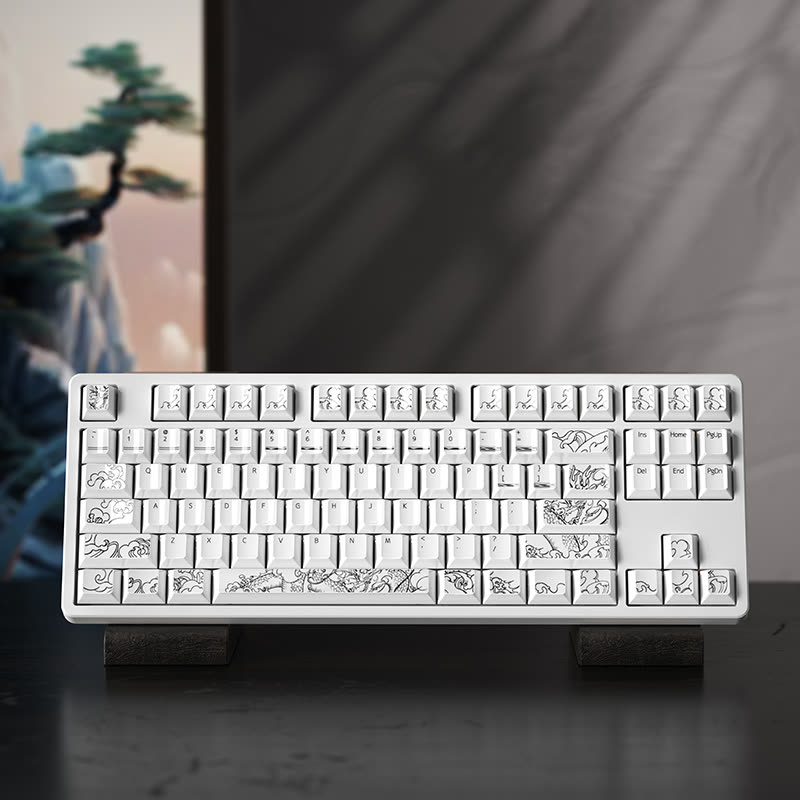
Ink is pushed through a fine screen (or picked up by a silicone pad) and transferred onto the keycap surface, one color at a time. It reproduces sharp logos and line art precisely and cheaply, and because it prints on top of the cap it works on materials dye-sub can't touch — including ABS, PC and transparent caps. A protective coating is applied to improve durability.
What silk-screen is best for
- Brand logos and single-color legends — crisp, exact, economical.
- PC, transparent and specialty caps — where dye-sub isn't possible.
- Ceramic-effect and decorative line art — like ink-wash and illustrated sets.
- Cost-sensitive runs — low setup, 500-set minimum.
Silk-screen vs the other processes
Silk-screen is the most economical printed option, but it sits on the surface, so for maximum permanence double-shot (molded legends) or dye-sublimation (dye inside PBT) last longer. Choose silk-screen when you want crisp logos or decorative art on specialty materials at a low minimum. Minimums across processes are in our MOQ guide.
FAQ
What is the MOQ for silk-screen keycaps?
500 sets. As a printed process there are no per-legend mould inserts, so the minimum is far lower than double-shot.
How durable is silk-screen printing?
It prints on the surface, so it's less permanent than double-shot or dye-sub; a protective coating improves wear resistance. Ideal for logos and decorative art.
Can it print on PC or transparent caps?
Yes — silk-screen suits PC, transparent and specialty caps where dye-sub isn't an option, and it's behind ceramic-effect sets.